26th October 2026 - Ordinary Weekday
First Reading: Ephesians 4: 32 – 5: 8/ Responsorial Psalm: Psalms 1: 1-2, 3, 4 and 6/ Alleluia: John 17: 17b, 17a/ Gospel: Luke 13: 10-17
Theme: When God Refuses to Give Up on You
- October 26, 2026
- 5:34 am
Dear Brothers and Sisters in Christ,
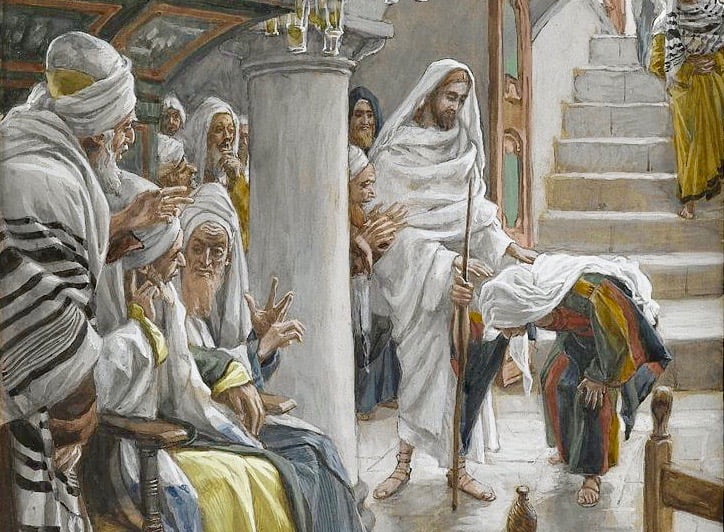
There is one detail in today’s Gospel that is easy to miss. The woman in the Gospel reading does not ask Jesus for healing. She has been bent over for eighteen years. Eighteen years of looking down. Eighteen years of carrying a burden in her body. And Jesus sees her. He calls her forward. He speaks to her. He touches her. The theme today is simple: God sees what has bent us down, even when we have stopped asking to be lifted up. God does not give up on us, even when we have given up on ourselves.
Sometimes suffering lasts so long that we begin to adjust to it. We stop expecting anything different. We learn how to live bent over. Maybe it is grief, resentment, disappointment, shame, loneliness, or something we have carried quietly for years. We still come to church, still pray, still smile, still do what needs to be done but inside, something has become heavy. And the danger is that after a while, we begin to think, “This is just who I am now.” But Jesus looks at this woman and refuses to define her by what has crippled her.
Then something surprising happens. Instead of rejoicing, the synagogue leader becomes angry because Jesus healed on the Sabbath. He is more concerned about the rule than the woman standing upright for the first time in eighteen years. And this is where the Gospel becomes uncomfortable, because it asks us: Can we become so religious that we stop noticing people? We can know the rules, say the prayers, attend Mass, and still miss the heart of God. Jesus is not rejecting the Sabbath; He is revealing what the Sabbath is for. It is meant to restore, to free, to remind us that we belong to God and not to our burdens.
Jesus calls her “a daughter of Abraham.” That matters. Before He speaks about her condition, He speaks about her identity. She is not “the crippled woman.” She is a daughter. And maybe some of us need to hear that today. Your deepest identity is not your wound, your failure, your sin, your diagnosis, your regret, or the worst thing that has happened to you. Before all of that, you are a son or daughter of God. Jesus does not simply want to fix something in you; He wants to restore you to the truth of who you are.
So perhaps the question is not only, “What do I need Jesus to heal?” Maybe the deeper question is, What have I become so used to carrying that I no longer bring it to Him? The woman had been bent over for eighteen years, but one encounter with Christ changed the direction of her life. She went from looking at the ground to standing upright and praising God. That is what grace does. It may not remove every difficulty immediately, but it lifts our eyes again. It reminds us that suffering does not get the final word. Christ does.
Prayer: Lord Jesus, You see the burdens I have carried for a long time, even the ones I have stopped talking about. Touch what is wounded in me. Free me from whatever keeps my heart bent down, and remind me again that I am Your beloved child. Help me to stand upright in Your grace and to notice those around me who also need compassion. Amen.
– Homily by Rev. Fr. Patrick Agbeko